
Understand TDS.
Account with clarity.
Turn tax deductions into a workflow you can follow. Practical guides to the rules, calculations and records behind confident business accounting.
For business owners, accountants and curious minds.
A deduction, explained.
Example only. Apply the verified rate and conditions for your transaction.
Different roles.
One clearer starting point.
Your obligations depend on the payment, the parties and the period. Find the perspective that fits your work.
Companies & firms
Connect supplier deductions, statutory liabilities and everyday accounts.
Professionals
Understand withheld receipts, net payments and the evidence behind tax credit.
Individuals & HUFs
Find the right starting point for business and specified personal payments.
Government offices
Follow deduction records, book adjustments and reporting responsibilities.
A little knowledge.
A lot more confidence.
Start with the essentials or go straight to the question on your desk.
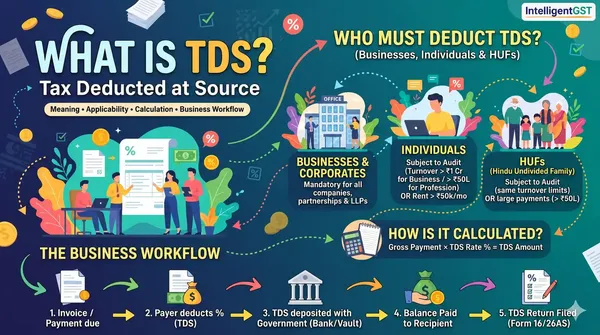
What Is TDS? Meaning, Calculation & Business Workflow
Understand TDS in India with deduction examples, ledger entries, tax-credit reconciliation and the April 2026 transition to the new income-tax framework.
Build your TDS foundation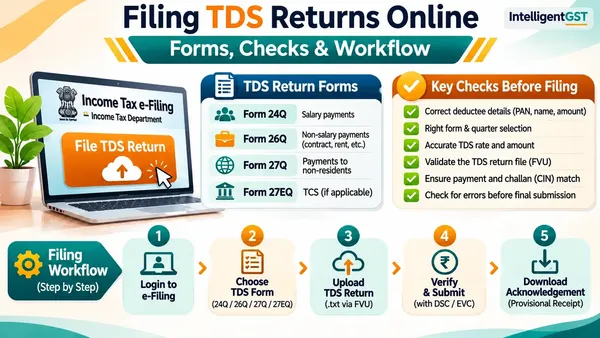
Filing TDS Returns Online: Forms, Checks & Workflow
Prepare and file TDS statements with the correct period, form, validation checks and acknowledgements, including current forms and historical corrections.
Read the guide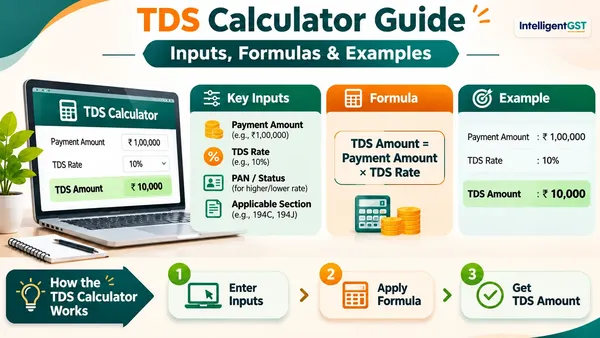
TDS Calculator Guide: Inputs, Formulas & Examples
Learn how a TDS calculator works, check the deduction base and threshold method, and review fixed-rate and gross-up examples before using a result.
Read the guide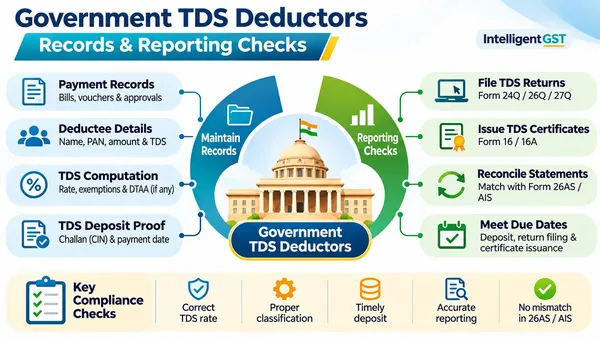
Government TDS Deductors: Records & Reporting Checks
Understand government income-tax TDS workflows, deduction-unit responsibility, challan and book-adjustment evidence, reconciliations and period-specific reporting.
Read the guide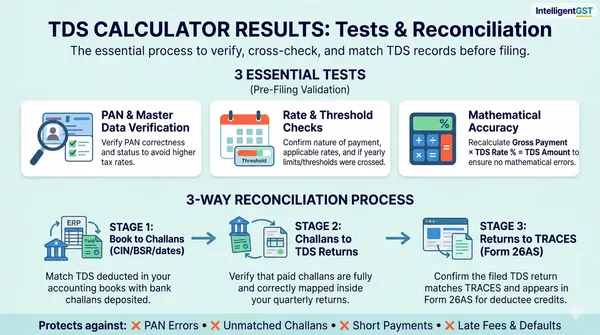
Check TDS Calculator Results: Tests & Reconciliation
Verify TDS calculator outputs using independent calculations, threshold boundary tests, rounding checks and a documented review of legal assumptions.
Read the guide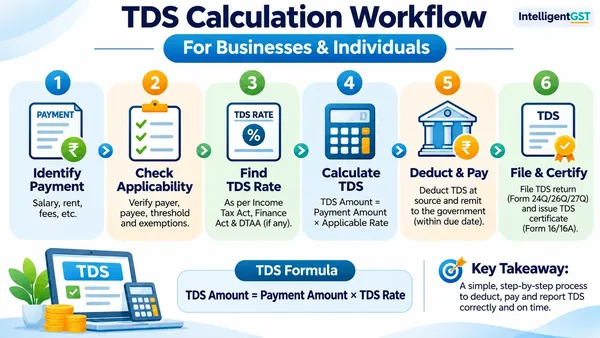
TDS Calculation Workflow for Businesses & Individuals
Build a repeatable TDS calculation process that connects source documents, approved rules, calculator outputs, ledger entries and reporting evidence.
Read the guide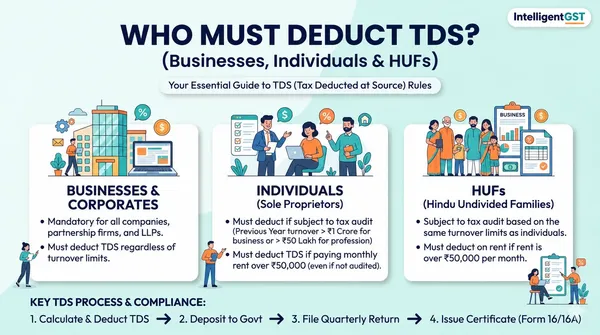
Who Must Deduct TDS? Businesses, Individuals & HUFs
Check who must deduct TDS using payer status, payment category, recipient facts and special transaction rules, with guidance for the April 2026 changeover.
Read the guide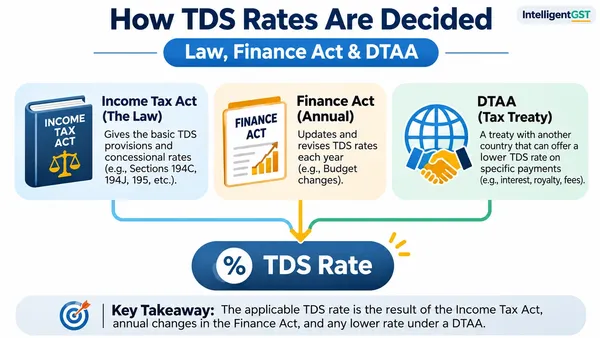
How TDS Rates Are Decided: Law, Finance Act & DTAA
Understand how TDS rates are selected from the applicable law, annual amendments, treaty conditions and certificates, with controls for maintaining rate masters.
Read the guideGood records make
every next step easier.
Classify
Establish the payment type, parties and applicable legal period.
Calculate
Confirm the base, threshold and approved rate before applying the formula.
Record & report
Keep the invoice, deduction, deposit and filing references connected.
Reconcile
Match the ledgers, statements and recipient’s tax-credit records.
The details behind
the deductions.
A practical reference to keep close. Open a topic to read the full explanation and supporting links.
01Getting started with TDS
Tax deducted at source affects much more than a tax payment at the end of the month. It changes how a supplier invoice is settled, how a customer receipt is reconciled and how tax credit reaches the recipient. The IntelligentGST TDS knowledge centre explains these connections through business examples, record-keeping checklists and links to official guidance.
Start with the complete explanation of TDS if you are learning the process. If you already handle deductions, use the guides below to investigate a particular workflow. The articles distinguish historical provisions from current-period requirements so that an older section number or form name is not mistaken for a universal instruction.
02What TDS does—and what it does not do
Under the income-tax withholding system, a specified payer deducts tax from a covered payment and deposits it with the government. The recipient normally receives credit for the reported deduction against their final income-tax liability. A supplier therefore needs to distinguish a genuine tax deduction from an unpaid commercial balance, while the payer needs to distinguish the supplier settlement from the amount still owed to the government.
TDS is not a discount on the supplier’s work. It is not automatically the recipient’s final tax, and it is not interchangeable with GST. These differences matter in daily accounts. Recording only the net bank transfer as an expense can hide the full charge, and recording a customer’s entire short payment as TDS without evidence can overstate the tax credit expected.
03Choose the right legal period before choosing a rate
India’s Income-tax Act, 2025 framework applies from 1 April 2026, while earlier-period obligations and corrections continue to require their applicable historical treatment. For many non-salary categories, the earlier of credit or payment determines the relevant trigger. Salary has its own withholding framework and should not be forced into every non-salary rule.
Suppose a business credits a contractor’s bill in March 2026 and transfers the balance in April. The later bank transfer does not automatically turn the March obligation into an April one. A new bill credited in April may need a different statutory reference, even when the contractor and commercial agreement are unchanged. Preserve both the accounting period and the legal reference in the records.
The Income Tax Department’s transition guidance is a useful starting point. The guides here use older section names where they help readers understand historical records and search for familiar topics, while explaining the current framework where verified.
04The six decisions behind a correct deduction
- Payment classification: read the agreement and invoice to establish whether the payment is for rent, professional services, contractual work, interest, goods or another covered category.
- Payer eligibility: check legal status, turnover conditions and any transaction-specific obligations. A rule for a company cannot automatically be applied to every individual.
- Recipient identity: obtain and verify the relevant PAN, legal constitution and residential-status information. Cross-border payments need separate attention.
- Threshold and base: identify whether the limit is monthly, annual, transaction-based or cumulative, and whether deduction applies to the full covered amount or only the excess.
- Rate and exception: confirm the period-specific rate and any certificate, declaration or statutory condition supporting a different treatment.
- Reporting route: determine which deposit, statement and certificate process applies, then retain the acknowledgements and reconcile the result.
Software can make these decisions easier to implement, but a transaction label alone cannot establish every legal fact. An accounts team should keep short classification notes for recurring categories and arrange review when contracts, turnover conditions or tax rules change.
05How to use these TDS guides
Read the introductory explanation before a specialist topic if the terminology is unfamiliar. For a supplier-payment issue, collect the invoice, agreement, payment dates and relevant ledger entries first. For a recipient-credit issue, collect the certificate and tax-credit statement alongside the invoices and bank receipts. Entering the discussion with a transaction reference is much more productive than asking why a total “looks wrong”.
Worked examples explain the assumptions before presenting a result. A percentage used in an example is not a recommendation for every transaction with a similar name. Check the applicability, period, deduction base and supporting evidence before adopting a calculation in live books. Where official details are required, follow the reference link instead of relying on an old downloaded screenshot.
06Build a monthly TDS review that people can actually follow
A practical review starts with the opening statutory-liability balance, adds new deductions and subtracts verified deposits and authorised adjustments. The result should agree with the closing TDS payable ledger. Reconcile that ledger to the underlying supplier or payroll transactions, then connect the records to the appropriate statement and acknowledgement.
Keep payment status and filing status separate. A challan can be paid while the statement is still pending, and a statement can be uploaded without having reached the final accepted status. Give each unresolved issue an owner, a document reference and a target date. The team should be able to tell whether it is waiting for a PAN correction, investigating an allocation or arranging an actual payment.
Recipients benefit from a corresponding reconciliation. Explain why a customer paid less than the invoice amount and identify the part supported as withholding. Compare expected tax credit with the appropriate government record. If a difference remains, send the deductor a clear transaction-level query and check the corrected position before closing the item.
07Forms, certificates and lower-deduction requests
Different documents serve different purposes. A statement reports deductions, a payment record identifies a deposit, and a certificate communicates prescribed deduction information to the recipient. A lower/nil deduction certificate supports a particular withholding treatment within its conditions; it does not replace the need to report transactions properly.
Current-period form changes make that distinction particularly important. Form 141 is the unified challan-cum-statement for specified transactions, with eligibility determined by its schedule and the parties. Form 128 concerns an application for lower or nil deduction. Form 121 concerns eligible declarations for non-deduction. These are not alternative names for one general TDS return.
Check the department’s forms transition FAQs and Form 141 guidance when identifying the process for a current transaction. Retain the period and original acknowledgement when dealing with a correction to an earlier filing.
08Using IntelligentGST for the supporting accounts
Test the accounting workflow with representative transactions before relying on it for live compliance. Your sample should include a gross invoice, a net settlement, a tax-liability entry, a government payment and a reconciliation. Add an advance or a correction if your business regularly encounters those situations.
Ask the IntelligentGST team for a demonstration covering the features available in your installed edition. Confirm supported reports, exports and integrations directly; an educational article is not a claim that every edition automatically files every income-tax form. You can also download the software and review the current licence options.
09Official references and editorial approach
These guides are written independently for IntelligentGST readers. Tax rules are checked against accessible Income Tax Department guidance and relevant official materials, with the review date shown on each article. Product examples explain accounting tasks without inventing integrations, filing guarantees, professional endorsements or customer statistics.
For the latest filing interface, use the official Income Tax e-Filing portal. For complex classifications, non-resident payments or a disputed notice, obtain advice based on the complete transaction facts. Last reviewed: .
Is income-tax TDS the same as GST?
No. Income-tax withholding and GST have different rules and reporting systems. There is also a separate GST TDS mechanism for specified deductors; it should be reviewed independently.
Does a calculator decide which rate applies?
A calculator applies its inputs. Confirm the payment category, parties, period, deduction base and threshold before relying on the result.
Does paying the tax finish the process?
Deposit, statement filing, certificate requirements and reconciliation are connected stages. Keep their records and status separately identifiable.
How do I see the IntelligentGST workflow?
Request a demonstration using your own transaction categories. Confirm the reports, exports and integrations supported by your installed edition.
Bring clarity
into your books.
Explore IntelligentGST with a workflow that makes sense for your business.
Tax explanations reviewed 20 November 2026. Check the applicable law and your transaction facts before acting.